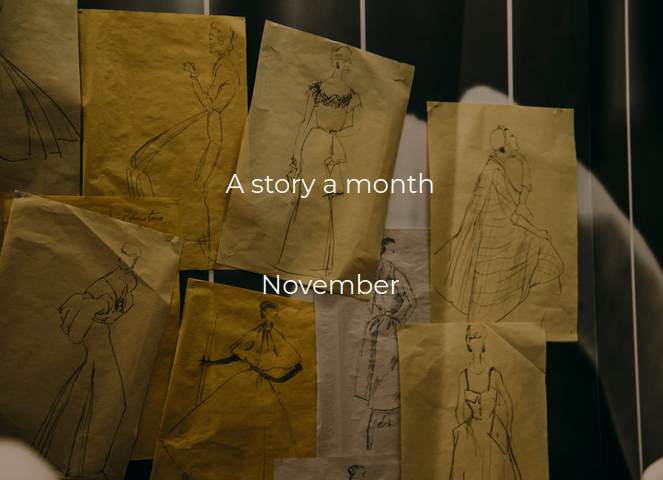
Josephine’s neck was stiff from being bent over her sketches. The edge of her right hand kept getting grey with graphite transferring the smudges to the creamy rough paper. She tried blowing on it and flicking it away, only to make it worse. She threw down a crayon on the tabletop in frustration regretting it immediately and picking it back up to check she hadn’t damaged the tip. She had been at it most of the evening. Her arms were sore from lifting heavy bolts of material but at least now she was sitting down, her feet snugly fitted in thick woollen socks. It was only half-past seven but it had been dark for already an hour and there was something comforting about the tip-tapping of rain on the roof. When she was small she would hide under the tall iron frame of her parent’s bed when the hailstorms swept through her sleepy little town. Her brother Yves would come and find her and tell her stories to make her laugh. She wished she could see her brother’s crooked smile again, since the armistice he had vanished in the south of France with a number of other young soldiers. The papers said they were traitors and deserters and their mother had had a seizure when they received the first letter telling them he was joining the resistance. Things had calmed down since then and she wished she could tell her brother about her new life in the capital. About the ornate iron metro stops, about the fashionable people that came into Tissus Duchamp to order magnificent fabrics, about her dream of one day meeting Coco Chanel herself. To keep safe, Yves never put a return address on his envelopes. Initially, their mother had started showering a distant cousin that lived in Aix-en-Provence with parcels of homemade jams and long johns convinced that they would somehow reach her son. However, at some point, she had to give up when the cousin sent a rather stern message inquiring if they had forgotten that her husband had died in the war and who were the long johns for anyway.
Things were calm now, but in a strange, holding your breath way. Like before a summer storm when the air is full of electricity. Josephine found she was always alert, sleeping with her ear to the door, like a cat. It was exhausting. The first months in the capital swept past her in a whirlwind of colourful fabrics, learning how to cut the fabric and then rip the last part straight, caressing velvet ribbing and wool, memorizing the different names and textures. It was thanks to her interest in the fabrics themselves that had led her to meet her first friend.
Jo’s first impression of Alain was rather poor. She had rushed over to save a distressed old man curved over the armrests of a wooden wheelchair, only to find a boy of her own age red with rage lifting himself up with the only strength of his upper body.Together they managed to free the chair under him that had got stuck in a rut between the wooden floorboards. He was sweating heavily from the effort and his long coat had got stuck underneath him when he sat back down, giving him a rather strangled look. Jo initially thought of offering him help to get out of the coat, but he still looked furious and she decided to offer him coffee from the storeroom instead. Sipping the sour drink amid the bolts of fabric she discovered that he was the son of a famous family of silk weavers from Lyon, the Maize. His mother was discussing business with Madame Duchamp in the back office.
– I find it mind-boggling that someone thought of using worms’ cocoons to make a thread. Imagine the first person to say ‘oh let’s try and spin this gooey lump’, everyone must have thought he was nuts!
Alain laughed. – I had never thought of it like that. For me, it’s just the thing that my family does, since always.
– Tell me about the silk weaving!
– Well, there are lots of machines – he replied grinning. – Now you are making me wish I had been more attentive during my uncle’s explanations.
– So, if not silk, what are you interested in?
– Well before I got stuck in this – he gestured towards the polished armrest – I drove fast cars.
– Oh, I’m sorry.
– There is nothing to be sorry about, I’m no war hero, I was simply going too fast around a corner.
– Well, I’m sorry you will not be able to drive again.
– Ah, well that is the good part actually. They are constructing a new kind of electric vehicle for people that have lost their legs. You know, after the war the demand is higher. I’ll show you, do you have some paper?
Alain’s mother and Madame Duchamp found them deep in discussion heads bent over a notebook. Josephine avoided a scolding for loitering with customers only because Madame Maize had thanked her profusely for taking care of her son. The business meeting had gone well too and Alain was back in the storeroom having coffee with her every fortnight.
As she thought of her friend she sketched the wheelchair and his profile. His lopsided fringe and very short hair on the sides gave him a rather angular face. He had the most expressive eyes she had ever seen, when he laughed they made her think of steamy hot cacao her mother would make before the war and when he was angry or upset they turned as unwelcoming as a freezing mud puddle. Checking her pocket watch, that was neatly tucked in the oversize cardigan she used as a home robe, she sighed. Time to get going. Drinking the rest of the sour-tasting chicory coffee she dipped a paintbrush in the dregs and cringing against the cold whipped off her woolly socks. As any good shop girl, she kept her precious stockings for working hours and resorted to a make-believe wobbly dark line going from her heel to the back of her thigh, that toed the line between decency and parsimony.
Thankfully the rain had stopped but a gust of cold air hit her as soon as she opened the door of her room. She made her way quietly along the carpeted narrow corridor to the staircase. Most of the small one-room flats in the area were rented by young shop assistants and there was a kind of solidarity spiked with the knowledge that no one would bat an eyelid at turning the other in for misbehaving if it came with a personal gain. By what she gathered from her mother’s letters, curfew was much more respected in the countryside. In Paris, especially in the colourful eighteenth arrondissement, hidden bars and underground dance halls were popping up everywhere. Some were more respectable than others and Jo was heading to a dingy staircase at the side of the Marché Saint Pierre, to an underground Café hosting improv artists. The person she was meeting was already at the round table in the corner, practically invisible in the dim red lighting and cigarette smoke. Jean Claude was an old friend of Yves and when he had come and found her in the shop she had squealed in joy. It was almost like seeing her brother again. The news he brought were however rather alarming. He had managed to scrape through the German controlling posts by walking for hours in the woods. He refused to tell her anything more other than her brother was fine and that they were living rough in the mountains.
– Well well, hasn’t our little Jojo grown up well. He said seizing her up and lifting a glass of whiskey in her direction.
– Stop looking at me like that, unless you are planning on making me a new suit. She replied tartly giving him a shove and grinning.
– Always the same, hein? I will tell Yves you can look after yourself. Do you have the drawings?
She passed him a cardboard folder, her sketches neatly stacked inside and took the seat opposite him. The stage was the only source of light and everyone was focused on the two improv comics that were recreating a scene of a woman finding rationing cards on the floor. The humour was satirical verging on dark.
On their first meeting, Jean Claude had been rather charming, asking about the shop, the customers and her work. He seemed rather bored when she went into detail of textures and styles and just for the laugh she had commented that maybe some famous designer would notice her and the heaviest thing she would lift all day would be a pencil. He was immediately interested and asked if she drew real people. She replied that it actually helped her remember important customers and it kept away the boredom in the evenings. He had kept his promise at their next meeting and handed over a swab of creamy sketching paper. Now she was holding up her end of the bargain showing him her sketches of the customers. She was not silly, she knew that he wasn’t interested in her shadowing technique, but she was ready to help her brother in whatever he needed, even if it consisted in sneaking about a bit.
He was holding the drawing to an angle peering at the faces in the dim light. His hair was rather dishevelled and he smelled as if it was not the first whiskey of the night.
– All these fucking traitors.
He jabbed a finger at the face of a lady that Jo had seen produce crisp rationing cards for dresses two weeks in a row.
– Nazi whore.
– Keep your voice down Jean Claude, I don’t want any problems.
– Don’t worry darling, as I said they will never know who’s our little taupe.
He scratched his chin – This is great, you have a talent for faces. And who is this fucker?
Jo’s blood ran cold as he waved a cigarette in the direction of Alain’s sketch.
– Is this the Maize heir? It must be, young guy on a wheelchair, floppy fringe.
– No, he’s not really a customer, he just ended up in the wrong pile of sketches.
Jo tried to grab the sheet of paper.
– I know who this guy is. His family is selling silks to the Nazis. Half of their workforce has been shipped to Germany. The traitor didn’t even fight in the war.
– No, no, you don’t understand, he couldn’t fight because of his legs and his mother takes all the decisions …
– Don’t tell me you’re actually defending this cripple?
– Keep your voice down! He’s not a bad person, please.
– Are you serious? Do you think anyone would care that your brother or myself are nice? No, because we would have a bullet in the back of our heads before you could even finish your drink!
With that he got up precariously and swept her sketches up, doffing his hat at her.
– Keep up the good job little one, next week same place same time.
She was left alone amid the laughter of the people watching the comics. Two new actors were on stage, a man with a crutch was pointing an accusing finger to a woman with grotesque makeup that was clutching a broom handle with a moustache pinned to it. As Josephine surfaced from the murky stairwell into the fresh air the actor’s bellowing voice followed her.
– You have to pick a side woman, it’s either me or him!
Disclaimer: The prompts for ‘A story a month’ are from Neil Gaiman’s project A Calendar of Tales (in collaboration with BlackBerry), but the content is mine. 🙂
Photo by Shuxuan Cao from Pexels

 Crafty Poulette